Sunday, 14 June 2015
Clear as day it's got to stop
#Clear as #day it's got to #stop
#warmachine #war #destruction #pollution #evil #greed #crimes #earth
https://youtu.be/B3ChLSljQjc

Sunday, 22 March 2015
Monday, 20 January 2014
Sunday, 5 May 2013
Law Enforcement
Enforcing the law is imperative, The people responsible must be prosecuted and convicted, the first domino must fall. Police must now do their job and arrest.
http://youtu.be/4MeUyUR8rE0
Further to this see
http://peoplesassemblyofjustice.blogspot.co.uk/2013/04/correct-action-and-moral-fortitude-and.html
http://youtu.be/4MeUyUR8rE0
Further to this see
http://peoplesassemblyofjustice.blogspot.co.uk/2013/04/correct-action-and-moral-fortitude-and.html
Wednesday, 19 September 2012
The lies that lead to war
The
lies that lead to war
How
the Government deceived Parliament, HM forces, the media and
the
public into waging illegal wars with Afghanistan, Iraq and Libya.
“War is essentially an evil thing. Its consequences are not confined to the
belligerent states alone, but affect the whole world. To initiate a war of aggression therefore, is
not only an international crime, it is the supreme international crime
differing only from other war crimes in that it contains within itself the
accumulated evil of the whole.”
Nuremburg War Crimes Tribunal
1946
The
method used by British Governments to persuade the nation to wage war is as old
as the hills - lie repeatedly about the illegality of war. The British Government used the same lie to
promote the war with Libya as it had done for the wars with Afghanistan and
Iraq - that military action by HM forces
is lawful and authorised by the UN Security Council operating under Chapter VII
of the UN Charter.
On
March 21st 2011, shortly before 559 MPs voted in favour of illegal military action against Libya, the UK
Government issued a statement making the false claim that the deployment of British
forces against Libya was lawful and authorised by UN Security Council
Resolution 1973; their note declared:
“The Attorney General has been consulted
and Her Majesty's Government is satisfied that this Chapter VII authorisation to use all necessary measures provides
a clear and unequivocal legal basis for deployment of UK forces and military
assets to achieve the resolution's objectives”.
This
Government statement, claiming that the armed attack on Libya would be legal,
exemplifies the way in which British politicians, lawyers and civil servants
pervert and break the law. By cross-checking
Government statements against the laws governing the use of force, it can
quickly be established that the wars with Afghanistan, Iraq and Libya are all illegal.
The law of war
The
two main legal documents which govern the use of armed force in international
affairs are the UN Charter and UN General Assembly Resolution 2625. The first lays down the law and the second
explains how to interpret it.
The UN Charter
The
UN Charter is the Statute which lays down the legally binding terms of this
agreement in 111 Articles. Article 2
states the purposes of the United Nations and includes these rules:
2.3 All members shall settle their international
disputes by peaceful means in such a manner that international peace, security
and justice are not endangered.
2.4 All members shall refrain in their
international relations from the threat or use of force against the territorial
integrity or political independence of any state, or in any other manner
inconsistent with the Purposes of the United Nations.
Chapter
VII of the UN Charter (Articles 39 - 51) contains the rules governing the measures
that the UN Security Council may take to bring about peace and security. Article 41 states:
The Security
Council may decide what measures not involving the use of armed force are to be
employed to give effect to its decisions, and it may call upon members of the
United Nations to apply such measures…
To
a person with common sense the phrase not involving
the use of armed force means not involving the use of armed force; so why do British Government
lawyers repeatedly claim that the UN Security Council has authorised the use of
armed force when it is clearly forbidden?
UN General Assembly Resolution 2625
In 1970 the United Nations agreed 51 new
definitions of the law governing in UNGA Resolution
2625:
DECLARATION ON PRINCIPLES OF INTERNATIONAL LAW
CONCERNING FRIENDLY RELATIONS AND
CO-OPERATION AMONG STATES IN ACCORDANCE WITH THE
CHARTER OF THE UNITED NATIONS
This
Declaration is one of the most important legal documents the world has ever
produced; yet few if any public office holders in Britain or America have seen
it or read it. It includes these rules:
Every State
has the duty to refrain in its international relations from the threat or use
of force against the territorial integrity or political independence of any
State, or in any other manner inconsistent with the purposes of the United
Nations. Such a threat or use of force
constitutes a violation of international law and the Charter of the United
Nations and shall never be employed as a means of settling international
issues.
No State or
group of States has the right to intervene, directly or indirectly, for any
reason whatever, in the internal or external affairs of any other State.
Consequently, armed intervention and all other forms of interference or
attempted threats against the personality of the State or against its
political, economic and cultural elements are in violation of international
law.
The
principles of the Charter which are embodied in this Declaration constitute
basic principles of international law, and consequently [the UN General Assembly] appeals to all States to be guided by these principles in their
international conduct and to develop their mutual relations on the basis of the
strict observance of these principles.
These laws are crystal clear. The use of force is prohibited. The use of armed force to attack other
nations is a crime. No state or group of
States such as NATO, ISAF[1]
or the EU, may intervene in another State’s affairs and every State must obey,
uphold and enforce these rules.
The crimes associated with waging aggressive war,
laid down in the Nuremburg Principles and the Rome Statute of the International
Criminal Court, are also clear. If any person, in furtherance of a state policy,
orders the use of force to attack members of a national, ethnic, racial or
religious group, that person and everyone who takes part in the attack is
responsible for the consequences, breaks international law and, if it results
in the deaths of innocent people, commits the universal crimes of genocide,
crimes against humanity, war crimes, aggression or conduct ancillary to such
crimes.
So
why do British and NATO politicians, lawyers and civil servants interpret
phrases such as all necessary measures,
humanitarian intervention, and not involving the use of armed force to
mean using weapons of mass destruction such as cruise missiles, rockets,
drones, bombs and radioactive munitions to invade and occupy Afghanistan and
Iraq or to attack Libya? Could the real
reason for these heinous decisions to kill innocent civilians and destroy
weaker nations be a psychopathic lack of conscience and moral values, or is it
perhaps because they know that they control the law enforcement processes and
can ensure that they will never be arrested, prosecuted or convicted for their
war crimes, for the suffering inflicted on their victims or the horrific
consequences of their decisions.
For more than sixty years UK
Government Ministers, officers and lawyers have deceived everyone over the
illegality of war and armed conflict and have got away with it. These massacres of Afghan, Iraqi and Libyan
civilians in which at least 450,000 children have died and more than 1m have
been injured and maimed since 2001 are the worst atrocities in British
history. Why is it then that not one
member of the UK establishment is willing to call a halt to the killing or
speak out against it? Why is it that
those with the power to stop the wars and enforce the laws repeatedly refuse to
do so?
It is time for law abiding
citizens everywhere to take a stand against Britain’s political, civil,
judicial and military leaders and institutions to ensure that the killing is
stopped, the resort to war is ended and those responsible for the deaths of
1.5m civilians are arrested and prosecuted for their crimes.
Chris Coverdale The
Peace Strike August 2012
[1]
the
International Security Assistance Force for Afghanistan
The Law is the Law. Police and Judges are bound by
position, duty and oath to uphold International and Domestic law. At present
they are in breach.
Principle III states, "The fact that a person
who committed an act which constitutes a crime under international law acted as
Head of State or responsible government official does not relieve him from
responsibility under international law."
Principle IV
The fact that a person acted pursuant to order of
his Government or of a superior does not relieve him from responsibility under
international law, provided a moral choice was in fact possible to him.
With immediate affect arrest of all of those whose
unlawful actions have directly resulted in, genocide, war crimes, crimes
against peace, crimes against humanity, abuse of Human and Civil rights and ecocide.
This is not a political issue, it is one of law.
Saturday, 9 June 2012
DECLARATION ON PRINCIPLES OF INTERNATIONAL LAW
Moscow has it right when it says that the UN along with the UK were in breach of international laws that are put in place and agreed to in order to prevent armed conflict. If one looks at the U.N charter it is clear that there is no other interpretation for the phrase "Not involving the use of armed force"
Arms dealing must be outlawed internationally, as it is a direct contravention and is not compliant with International laws. Weapons manufacturer's and suppliers are responsible for crime's against peace, crimes against humanity, genocide, human right abuses and violations.
All governments must be brought to book by their people and the LAW for breaking International LAWS.
http://www.un.org/en/documents/charter/chapter1.shtml
The Purposes of the United Nations are:
To maintain international peace and security, and to that end: to take effective collective measures for the prevention and removal of threats to the peace, and for the suppression of acts of aggression or other breaches of the peace, and to bring about by peaceful means, and in conformity with the principles of justice and international law, adjustment or settlement of international disputes or situations which might lead to a breach of the peace;
The wars with Afghanistan, Iraq and Libya are illegal because they violate the UN Charter, the Treaty for the Renunciation of War and the Rome Statute. Anyone who took part in actions in which civilians were killed is criminally liable for arrest and prosecution for war crimes under the International Criminal Court Act 2001.
The UN Charter
The United Nations is an organization of 193 independent nation states which have promised on behalf of their people to work together to maintain international peace and security and to save succeeding generations from the scourge of war. The UN Charter lays down the binding terms of this agreement in 111 Articles.
2.3 All members shall settle their international disputes by peaceful means in such a manner that international peace, security and justice are not endangered.
2.4 All members shall refrain in their international relations from the threat or use of force against the territorial integrity or political independence of any state, or in any other manner inconsistent with the Purposes of the United Nations. 1 Chapters VI and VII of the UN Charter (articles 33 – 51) govern the operations of the UN Security Council.
41. The Security Council may decide what measures not involving the use of armed force2 are to be employed to give effect to its decisions, and it may call upon the Members of the United Nations to apply such measures. These may include complete or partial interruption of economic relations and of rail, sea, air, postal, telegraphic, radio, and other means of communication, and the severance of diplomatic relations.
42. Should the Security Council consider that measures provided for in Article 41 would be inadequate or have proved to be inadequate, it may take such action by air, sea, or land forces as may be necessary to maintain or restore international peace and security. Such action may include demonstrations, blockade, and other operations by air, sea, or land forces of Members of the United Nations.
UN General Assembly Resolution 2625
In the 1960s the United Nations, concerned that States were misinterpreting the UN Charter, asked the International Law Commission to tighten the rules so that all States would be clear on their meaning. In 1970 this work came to fruition when the UN General Assembly agreed and published in UNGA Resolution 2625 the Principles to be used in interpreting the Charter.
DECLARATION ON PRINCIPLES OF INTERNATIONAL LAW CONCERNING
FRIENDLY RELATIONS AND CO-OPERATION AMONG STATES
IN ACCORDANCE WITH THE CHARTER OF THE UNITED NATIONS
Amongst its many important principles are the following:
Every State has the duty to refrain in its international relations from the threat or use of force against the territorial integrity or political independence of any State, or in any other manner inconsistent with the purposes of the United Nations. Such a threat or use of force constitutes a violation of international law and the Charter of the United Nations and shall never be employed as a means of settling international issues.
No State or group of States has the right to intervene, directly or indirectly, for any reason whatever, in the internal or external affairs of any other State. Consequently, armed intervention and all other forms of interference or attempted threats against the personality of the State or against its political, economic and cultural elements are in violation of international law.
The principles of the Charter which are embodied in this Declaration constitute basic principles of international law, and consequently [the General Assembly] appeals to all States to be guided by these principles in their international conduct and to develop their mutual relations on the basis of the strict observance of these principles.
Monday, 21 May 2012
The Queen and War Crimes
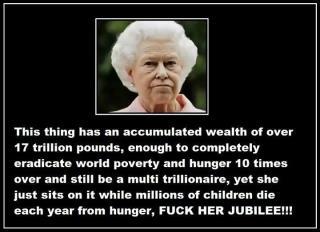
The Labour MP Ronnie Campbell is known as a plain speaker. He called the
Queen a "fifth generation German" with no right to rule over him.
In this month's Total Politics magazine he said: "Why
should we be ruled over by families descended from robber barons, bandits and
illegitimate heirs?
"Or, in the case of the current lot, fifth-generation
Germans who changed their name from Battenberg to Windsor during the First World War.
“Start Quote
Why should we be ruled over by families descended from
robber barons, bandits and illegitimate heirs?”
Ronnie Campbell MPLabour, Blyth
"By what right do they lord it over us? Why should me
and mine, who bend knees to no one, be regarded as 'subjects' rather than
'citizens'?"
He compounded that this week by also attacking the plan to
rename the tower containing Big Ben as Elizabeth Tower
Police March May 10th
Duty of Care and Responsibility
The queen of England; War Criminal responsible for the death's of millions of people, many of which are women and children.
The Laws Of War
Subscribe to:
Posts (Atom)